Wednesday, December 10, 2014

Climate Change Impacts in Brazil

Specific Climate Impacts

Impacts facing Central and South America are Physical, Biological, and Human and managed systems.  Rapid melting of glaciers and snow ice in the Andes will significantly change stream flow rates causing droughts in some areas.  Extreme precipitation will highly impact urban areas threatening flooding and landslides. Changes in the hydrological cycle will decrease food production. As temperatures rise in higher latitudes as well as elevations, the potential risk for "vector-borne diseases" (Summary for Policy Makers, 24) will effect larger portions of the continent's population.

Regional Climate Projections

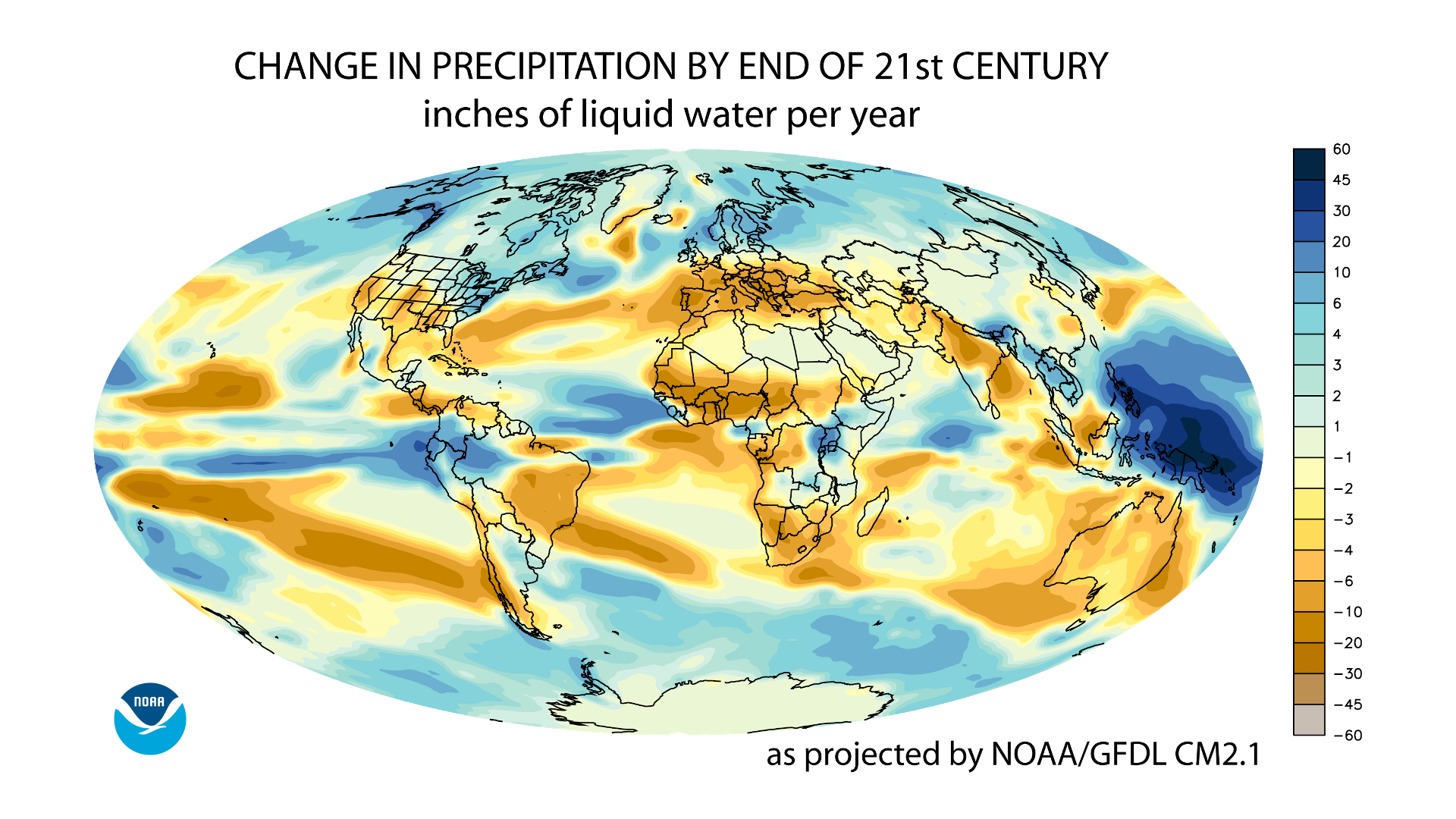
It seems South America has a lot of change coming its way.  According to very sophisticated climate models South America is on it's way to having higher temperatures everywhere.  The systems say the Amazon will experience the largest changes.  But before we get into that, let's look at what's been recorded so far in the last 20 - 30 years.  Major glacial retreat in the Andes, a gradual increase in temperature over the interior of the continent, and a gradual cooling along the coast.  Precipitation observations have also been observed with big increases in the southeast as well as in the Northwest of Peru and central-northern Argentina.  There don't seem to be many negative observations, mostly in Central America and central-southern Chile.

So what do the computer models predict?  First, everywhere is going to get warmer, with the greatest change in the eastern Amazon region. Cool nights in the future will be warmer than current cold nights. The southeast and northwest will see increases in rainfall. The eastern Amazon, eastern and northeastern areas of Brazil will see decreases in precipitation, it seems mostly in the dry season.

Detailed Look at Future Climate

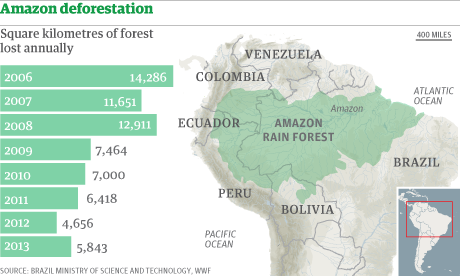
Increase in high temperatures in Central America, tropical and subtropical regions of the continent. Water supply shortages will increase because of less rainfall and more evaporation and transpiration as a result of higher temps.  Chopping down the forests to make more room for agriculture and cattle ranching intensifies the effects of climate change.  Though the rate of deforestation has slowed as seen in the image below, the ecological effects exacerbate climate change such as loss of  biodiversity and increase of species extinction.

Source: http://www.theguardian.com/environment/2013/nov/15/amazon-deforestation-increased-one-third

The continent has large groups of impoverished populations who are more vulnerable to climate change. Natural resources used for daily living become more scarce, and thus risks of malnutrition, lack of sanitation, and disease become more prevalent.  It's somewhat uncertain as to how the continent's food supply will be effected.  In some regions, decrease in precipitation will surely present new challenges, but projections for the Southeast show increases in rainfall, and thus potentials for greater productivity.

Source: http://en.wikipedia.org/wiki/Physical_impacts_of_climate_change


Most Interesting Threat

Climate change in South America is having measurable impacts on human health.  There are new diseases popping up in non-endemic areas, places the disease never existed.  What has changed you ask, why yes air temperature.  Mosquitos like it hot.  Malaria has been documented to have reached high in the Bolivian Andeas, where normally it's too cold for those midgies to survive.  They bring with them Malaria and Dengue fever.  But new habitats for mosquitos aren't the only issues.  There are many other diseases such as the Schistosomiasis, Hantaviruse, Chagas disease, cutaneous leishmaniasis, river blindness, and cholera will each expand it's geographical domain.  I chose this topic because I don't think about non-endemic viruses stretching their "wings" and flying to other places.  But that's exactly what is happening.
Sixteen studies met the inclusion criteria and most studies showed that the transmission of dengue is highly sensitive to climatic conditions, especially temperature, rainfall and relative humidity. Studies on the potential impacts of climate change on dengue indicate increased climatic suitability for transmission and an expansion of the geographic regions at risk during this century. Source: http://www.biomedcentral.com/1471-2334/14/167
My perception of climate change has been sea level rise, loss of habitat, changes in temperature, precipitation.  More drought less rain.  I never considered the public health aspect and how these challenges can have an even greater impact on populations where public health issues are presently major concerns without the added burden climate change brings.
Source: http://explorelochlomond.co.uk/midgie.htm


Sunday, December 7, 2014

Severe Weather in Brazil


Tornados

There several conditions needed for the development of a tornado.  First, wind shear is needed to produce a rotating horizontal air mass.  Next, a thunderstorm's updraft is needed to lift the horizontal rotating air mass into the storm as a vertical air mass.  This is called a mesocylcone.  A funnel cloud may develop from the mesocyclone.  The funnel cloud emerges from the wall cloud and as soon as it touches the ground it is called a tornado.  Tornadoes travel with the storm system in the US typically a westward to eastward direction rotating counterclockwise due to the westerlies.

Brazil has experienced tornados mostly in the south and southeast regions.  It appears that much of the population believed tornados were very rare.  An official government tornado registry did not exist in 2011.  Weather enthusiasts have created sites in Brazil for citizens to self-report.  As a result, there was a 10-fold increase in tornados reported over the last decade.  Some attribute this to climate change other's say it's simply because of the accessibility to reporting mechanisms.

In the US, about 1,200 tornados are reported annually.  In comparison, only 5 "notable" tornados were listed on Wikipedia for Brazil.  Tornados are rare but not uncommon in Brazil. However, with the lack of an official registry, it's unclear as to the prevalence these events occur.

Here is an old outdated map created by the famous tornado researcher Fujita to give an idea of where tornado's usually occur on a global scale.  You can see that Brazil and Uruguay have several dots.  As you can see, most tornados occur in the Mid-Latitudes.

Source:  http://www.pbs.org/wgbh/nova/earth/tornado-country.html
My best guess as to why tornados have increased over time is because of an increase in population sprawling over a larger geographical area.  Taking this factor into consideration with an increase in technological communications, I believe more people are seeing and sharing tornado experiences than ever before.

Hurricanes

The three requirements for hurricane formation are deep warm ocean water, hot surface water to fuel evaporation and a Coriolis to initiate spinning.  Brazil's coastline extends along the South Atlantic ocean, which had never officially recorded a hurricane until 2004.  The conditions of the South Atlantic make hurricanes very rare.  The upper level winds are very strong, discouraging to storm development. Sea surface temperatures are colder, hot water is the fuel.  Finally, there's no convergence, ITCZ.  But in 2004 Cyclone Catarina took everyone by surprise.  A combination of unusual events occurred to produce this storm.  An upper level low was cut-off and then blocked by a stationary High. Lots of moisture traveling southeastward off the South American continent thus was also blocked, feeding strong thunderstorms in the Low pressure air mass over slightly cool water.

Cyclone Catarina
Source: https://courseware.e-education.psu.edu/public/meteo/Images/Section8/brazilcyclone_lowres0805.jpg

Hurricanes form in the regions illustrated in the graphic below. There are several names for tropical cyclones.  In the Northern Hemisphere near North America, they are called hurricanes.  In the North Pacific near Southeast Asia and India they are called Typhoons.  Lastly in the Southern Hemisphere they are simply called cyclones.

Source: http://www.learnnc.org/lp/editions/nchist-recent/6248

In the US, hurricanes in the Atlantic usually travel from low latitude eastern warm water toward midlatitudes traveling northwest, north, and even northeast.  They begin off the coast of North Africa fueled by prevailing winds and warm deep water once arriving at the Gulf Stream.  They swing northward and continue in that direction until flow from the Westerlies takes them north -northeast.

Hurricanes do not normally occur in Brazil. The average number of hurricanes to hit the US per year is about 1.72 per year. As described above, only Cyclone Catarina has ever been recorded to strike Brazil.


Wednesday, November 5, 2014

Daily Weather in Brasilia

Three Day Forecast for Brasilia

The following forecast was for Nov 5 through Nov 7, 2014  To start things off, Wednesday, the 7th had  a high of 83F and a low of 68F with a 80% chance of rain.   On Thursday the weather improved with a 10% chance of rain in the very early morning. The high increased to 88F with night time temperatures dropping to 67F.  For Friday, clear skies with a high off 88F and a low of 68F with a 20% chance of showers near sunset. Average pressure was 29.91 in.  The pressure decreased slightly over the full 3 days with the first day, peaking at 30.01 inch on Thursday and then falling to 29.93 the following day at the same time.  The average wind speed was 9.3 mph and stayed about the same over all three days with a maximum on Friday of 11 mph.

Current Satellite Image

image source: wunderground
At the time of screen capture, clouds were present over the eastern surrounding area of the city with clear skies in the western and central regions of the city.  Warm low level warm clouds resided over much of the area with a very cold high level system to the north moving southwards.  Radar revealed no precipitation.  The feature on Wunderground.com may have not been working properly as I was not able to see any precipitation at various zoom levels.  Zooming in on the locale, one can see the city sits in a high basin beside a man-made lake. Dendritic streams flow from the surround mountainous region into several dammed lakes. The area's vegetation is abundant including in and around urban centers. 

Regional Patterns of Low and High Pressure and Fronts

image source: intellicast


Above we have the current surface forecast for South America.  We can see High pressure in the lower latitudes and Low pressure in the higher latitudes.  Isobar pressure of the strongest High's are at 1024mb on the west coast and mid Atlantic, and 1016mb over southern Brazil.  A low of 988mb of the east coast  has an associated stationary front that is providing some weather to our beautiful capital city Brasilia. Let's go in and take a closer look.

image source: intellicast
Above we can see the stationary front associated with the low pressure system in the Atlantic.  With High pressure moving on the western side of the cool air and warm air coming in from the north, Brasilia is getting some precipitation today.  The forecast called for 80% chance of rain.  This front should move south and east as the low pressure system is pushed to the south by the two High pressure systems to the west and east.


Wednesday, October 29, 2014

Global and Local Winds in Brazil

Location and Global Wind

Brazil's geographic location has it in both the Northern and Southern Hemispheres, stretching from just over 30S to about 5N and roughly 35W to 73W.  The behemoth thus has the pleasure of entertaining Hadley Cells in both the North and Southern hemisphere, but mostly south.  Easterly trade winds associated with a subtropical high blow from the southeast providing a fairly moderate climate for much of the country.   The southern portion of the country has the good fortune of being on the boarder between the Hadley and Ferrel Cells.  Westerly winds originating in higher southern latitudes cool the region and occasionally bring dusting's of snow to higher elevations.  With the equator crossing through the heart of the Amazon region to the north, low pressure doldrums persist bringing incredibly stable temperatures year round. 

Global Wind and Weather & Map

Local Winds

The mountainous region is located along the east coast beginning in the south and stretches northeastward up the coast. Of the five wind types, mountain and valley winds Foehn or Chinook wind, Katabatic winds, Santa Ana winds, the dry central southern region does experience Foehn winds. 
There are at least two local types of wind in Brazil.  The Abrolhos is a squall wind that happens during winter near 18S and typically happens when an Antarctic cold front reaches warm southeast trades that have aquired a boatload of moisture over the Brazilian current, which flows southwest begging around 10S.  The second type is a Minuano that occurs much further South.  These take place when very High Pressure is to the North and cold polar fronts from the southwest of the continent meet warm stationary humid air.


Friday, October 10, 2014

Typical Weather and Tourism in Brazil


Weather on the Winter Solstice

June 21st is the winter solstice since almost all of Brazil is in the Southern Hemisphere.  However just north of the Amazon there is a thin slice of the country that is in the Northern Hemisphere, in which case Dec 21st would be the Winter Solstice.  Temperatures in this area stay on average 79F year round. There is very little fluctuation.  However, for the southern hemisphere Brazil is a different story.

The average maximum temperature in June is 88F found in the city of Manus, only 180 nm south of the equator or about 3 degrees.  It gets colder as you travel south on this day.  Go about 1,400nm south of the equator to the city of San Paulo and you will find an average minimum temperature of 56F.  It can get even colder in the higher elevations of the south, and on the rare occasion it snows there. But for the rest of the country, you'll find rain on this day.

Weather on the Summer Solstice

The summer solstice occurs in the southern hemisphere on December 21st and June 21st for that tiny Amazonian area in the north of the territory.  The maximum temperature during December is 88F in Manus again.  The temperature never seems to change there.  The average minimum temperature is in Sao Paulo again, but warmer, at 65 F.  We would find a lot of rain in the Sao Paulo this time of year. Definitely don't spend the Christmas/New Years holiday there. 

Weather on the Spring Equinox

September 23rd  in Brazil is the Spring Equinox for the majority of the country.  The average maximum temperature is found in our now familiar river town, Manus, once again.  A steady 92F keeps that city hoping.  The average minimum temperature on this day is back in Sao Paulo at 58F.  Going to find rain on this day for sure.  Brazil loves rain like it loves it's plastic surgery. 

Weather on the Autumn Equinox

March 20th, just 72 hours following my favorite holiday, that being St. Patrick's Day.  Will the clouds turn into green shamrocks precipitating green beer on this day in Brazil?  Let's find out. The average maximum temperature is in Manaus at a comfortable 88F.  This could lead to late afternoon beerecipitation.  But what's going on in the south? The average minimum temperature is in Sao Paulo at 67.  Now that's good St. Patrick's day weather.  Rain is the primary form of precipitation on the Autumn Equinox, just enough to rehydrate everyone from the festivities.

Travel Agent Advice

I would recommend travel just after the Autumn Equinox.  Summer is coming to a close, temperatures are moderate for most of the country ranging in the 70s to 80s F.  In some parts of the country it may be a bit cool to swim, but you will find excellent opportunities for hiking and enjoying the outdoors.

Severe weather in the country is nearly non-existent in March.  However, March is the prime month for hurricanes in the South Atlantic, as it is the month where the water is the warmest.  Hurricanes' are very, very rare in the Sout Atlantic, especially along the east coast of the country, but it has happened.  In 2004, a category 2 hurricane, Catarina struck the state of Santa Catarina. 

Image source: http://upload.wikimedia.org/wikipedia/commons/thumb/5/5f/Panorama_Ibirapuera.jpg/1000px-Panorama_Ibirapuera.jpg
More than just soccer, carnival, and bikini's - Brazil, relax -
take a walk in the park.


 Temperature Source: http://www.gate1travel.com/south-america-travel/weather/Brazil-weather.htm

Friday, October 3, 2014

Temperature Controls in the city of Brasilia in Brazil

Image from: https://farm6.staticflickr.com/5015/5441482134_b04e1aab7f_b.jpg
Capital City: Brasilia 15.7989° S, 47.8667° W

The city's warmest month is September with an average monthly temperature of 71.1 F.
The coldest month is July with an average monthly temperature of  64.9 F

Based on the information above the annual range of temperature for Brasilia is 6.2 F

Retrieved from: http://en.wikipedia.org/wiki/Bras%C3%ADlia

Geographic Location

Elevation is one temperature control that has a major impact on Brasilia's regional temperature. At an elevation of 3,845ft and at 15.7989 South, the city has a very moderate tropical climate. The higher elevation keeps the city cooler than it otherwise would be at sea level for this latitude.

One temperature control that does not impact Brasilia are ocean currents.  The city is approximately 765 miles from the coast of the South Atlantic Ocean.  Thus, cool water traveling upward along Brazil's coastline from the south does not have an impact on the city's regional temperature.

Temperature, Climate and the Future

The Intergovernmental Panel on Climate Change released a report called: Climate Change 2014: Impacts, Adaptation, and Vulnerability.  In this report, the general consensus for the northern part of Brazil is that it will get drier and the southern highlands will become wetter.  The report also states:  
There is medium confidence that droughts will intensify along the 21st century in some seasons and areas due to reduced precipitation and/or increased evapotranspiration in Amazonia and Northeast Brazil.
To the south is much of the country's agriculture sector.  The prediction for this area is that it will receive an increase in rainfall and higher probability for flooding.