Wednesday, December 10, 2014

Climate Change Impacts in Brazil

Specific Climate Impacts

Impacts facing Central and South America are Physical, Biological, and Human and managed systems.  Rapid melting of glaciers and snow ice in the Andes will significantly change stream flow rates causing droughts in some areas.  Extreme precipitation will highly impact urban areas threatening flooding and landslides. Changes in the hydrological cycle will decrease food production. As temperatures rise in higher latitudes as well as elevations, the potential risk for "vector-borne diseases" (Summary for Policy Makers, 24) will effect larger portions of the continent's population.

Regional Climate Projections

It seems South America has a lot of change coming its way.  According to very sophisticated climate models South America is on it's way to having higher temperatures everywhere.  The systems say the Amazon will experience the largest changes.  But before we get into that, let's look at what's been recorded so far in the last 20 - 30 years.  Major glacial retreat in the Andes, a gradual increase in temperature over the interior of the continent, and a gradual cooling along the coast.  Precipitation observations have also been observed with big increases in the southeast as well as in the Northwest of Peru and central-northern Argentina.  There don't seem to be many negative observations, mostly in Central America and central-southern Chile.

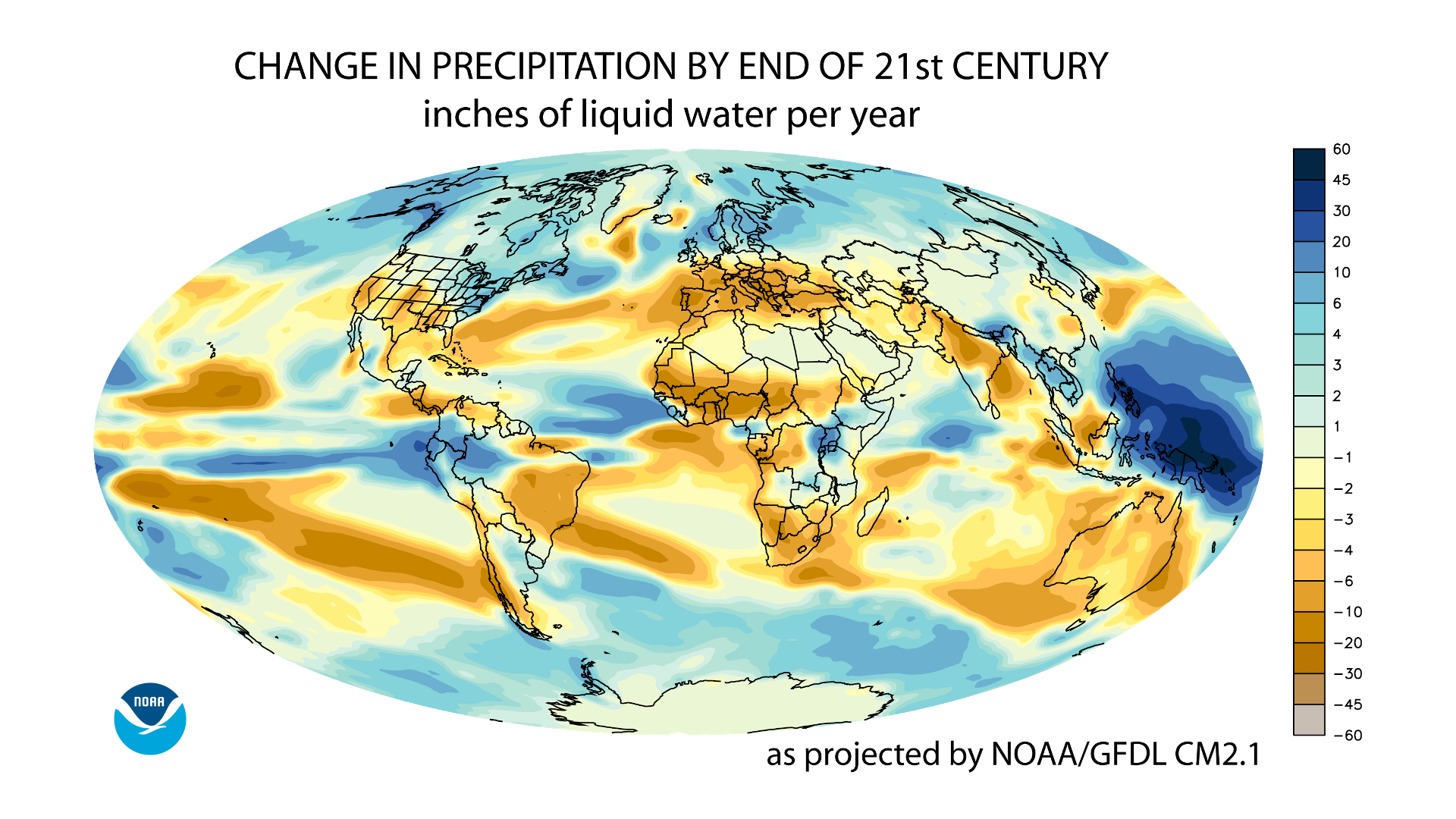
So what do the computer models predict?  First, everywhere is going to get warmer, with the greatest change in the eastern Amazon region. Cool nights in the future will be warmer than current cold nights. The southeast and northwest will see increases in rainfall. The eastern Amazon, eastern and northeastern areas of Brazil will see decreases in precipitation, it seems mostly in the dry season.

Detailed Look at Future Climate

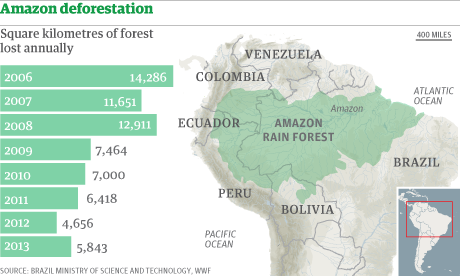
Increase in high temperatures in Central America, tropical and subtropical regions of the continent. Water supply shortages will increase because of less rainfall and more evaporation and transpiration as a result of higher temps.  Chopping down the forests to make more room for agriculture and cattle ranching intensifies the effects of climate change.  Though the rate of deforestation has slowed as seen in the image below, the ecological effects exacerbate climate change such as loss of  biodiversity and increase of species extinction.

Source: http://www.theguardian.com/environment/2013/nov/15/amazon-deforestation-increased-one-third

The continent has large groups of impoverished populations who are more vulnerable to climate change. Natural resources used for daily living become more scarce, and thus risks of malnutrition, lack of sanitation, and disease become more prevalent.  It's somewhat uncertain as to how the continent's food supply will be effected.  In some regions, decrease in precipitation will surely present new challenges, but projections for the Southeast show increases in rainfall, and thus potentials for greater productivity.

Source: http://en.wikipedia.org/wiki/Physical_impacts_of_climate_change


Most Interesting Threat

Climate change in South America is having measurable impacts on human health.  There are new diseases popping up in non-endemic areas, places the disease never existed.  What has changed you ask, why yes air temperature.  Mosquitos like it hot.  Malaria has been documented to have reached high in the Bolivian Andeas, where normally it's too cold for those midgies to survive.  They bring with them Malaria and Dengue fever.  But new habitats for mosquitos aren't the only issues.  There are many other diseases such as the Schistosomiasis, Hantaviruse, Chagas disease, cutaneous leishmaniasis, river blindness, and cholera will each expand it's geographical domain.  I chose this topic because I don't think about non-endemic viruses stretching their "wings" and flying to other places.  But that's exactly what is happening.
Sixteen studies met the inclusion criteria and most studies showed that the transmission of dengue is highly sensitive to climatic conditions, especially temperature, rainfall and relative humidity. Studies on the potential impacts of climate change on dengue indicate increased climatic suitability for transmission and an expansion of the geographic regions at risk during this century. Source: http://www.biomedcentral.com/1471-2334/14/167
My perception of climate change has been sea level rise, loss of habitat, changes in temperature, precipitation.  More drought less rain.  I never considered the public health aspect and how these challenges can have an even greater impact on populations where public health issues are presently major concerns without the added burden climate change brings.
Source: http://explorelochlomond.co.uk/midgie.htm


Sunday, December 7, 2014

Severe Weather in Brazil


Tornados

There several conditions needed for the development of a tornado.  First, wind shear is needed to produce a rotating horizontal air mass.  Next, a thunderstorm's updraft is needed to lift the horizontal rotating air mass into the storm as a vertical air mass.  This is called a mesocylcone.  A funnel cloud may develop from the mesocyclone.  The funnel cloud emerges from the wall cloud and as soon as it touches the ground it is called a tornado.  Tornadoes travel with the storm system in the US typically a westward to eastward direction rotating counterclockwise due to the westerlies.

Brazil has experienced tornados mostly in the south and southeast regions.  It appears that much of the population believed tornados were very rare.  An official government tornado registry did not exist in 2011.  Weather enthusiasts have created sites in Brazil for citizens to self-report.  As a result, there was a 10-fold increase in tornados reported over the last decade.  Some attribute this to climate change other's say it's simply because of the accessibility to reporting mechanisms.

In the US, about 1,200 tornados are reported annually.  In comparison, only 5 "notable" tornados were listed on Wikipedia for Brazil.  Tornados are rare but not uncommon in Brazil. However, with the lack of an official registry, it's unclear as to the prevalence these events occur.

Here is an old outdated map created by the famous tornado researcher Fujita to give an idea of where tornado's usually occur on a global scale.  You can see that Brazil and Uruguay have several dots.  As you can see, most tornados occur in the Mid-Latitudes.

Source:  http://www.pbs.org/wgbh/nova/earth/tornado-country.html
My best guess as to why tornados have increased over time is because of an increase in population sprawling over a larger geographical area.  Taking this factor into consideration with an increase in technological communications, I believe more people are seeing and sharing tornado experiences than ever before.

Hurricanes

The three requirements for hurricane formation are deep warm ocean water, hot surface water to fuel evaporation and a Coriolis to initiate spinning.  Brazil's coastline extends along the South Atlantic ocean, which had never officially recorded a hurricane until 2004.  The conditions of the South Atlantic make hurricanes very rare.  The upper level winds are very strong, discouraging to storm development. Sea surface temperatures are colder, hot water is the fuel.  Finally, there's no convergence, ITCZ.  But in 2004 Cyclone Catarina took everyone by surprise.  A combination of unusual events occurred to produce this storm.  An upper level low was cut-off and then blocked by a stationary High. Lots of moisture traveling southeastward off the South American continent thus was also blocked, feeding strong thunderstorms in the Low pressure air mass over slightly cool water.

Cyclone Catarina
Source: https://courseware.e-education.psu.edu/public/meteo/Images/Section8/brazilcyclone_lowres0805.jpg

Hurricanes form in the regions illustrated in the graphic below. There are several names for tropical cyclones.  In the Northern Hemisphere near North America, they are called hurricanes.  In the North Pacific near Southeast Asia and India they are called Typhoons.  Lastly in the Southern Hemisphere they are simply called cyclones.

Source: http://www.learnnc.org/lp/editions/nchist-recent/6248

In the US, hurricanes in the Atlantic usually travel from low latitude eastern warm water toward midlatitudes traveling northwest, north, and even northeast.  They begin off the coast of North Africa fueled by prevailing winds and warm deep water once arriving at the Gulf Stream.  They swing northward and continue in that direction until flow from the Westerlies takes them north -northeast.

Hurricanes do not normally occur in Brazil. The average number of hurricanes to hit the US per year is about 1.72 per year. As described above, only Cyclone Catarina has ever been recorded to strike Brazil.