Specific Climate Impacts
Impacts facing Central and South America are Physical, Biological, and Human and managed systems. Rapid melting of glaciers and snow ice in the Andes will significantly change stream flow rates causing droughts in some areas. Extreme precipitation will highly impact urban areas threatening flooding and landslides. Changes in the hydrological cycle will decrease food production. As temperatures rise in higher latitudes as well as elevations, the potential risk for "vector-borne diseases" (
Summary for Policy Makers, 24) will effect larger portions of the continent's population.
Regional Climate Projections
It seems South America has a lot of change coming its way. According to very sophisticated climate models South America is on it's way to having higher temperatures everywhere. The systems say the Amazon will experience the largest changes. But before we get into that, let's look at what's been recorded so far in the last 20 - 30 years. Major glacial retreat in the Andes, a gradual increase in temperature over the interior of the continent, and a gradual cooling along the coast. Precipitation observations have also been observed with big increases in the southeast as well as in the Northwest of Peru and central-northern Argentina. There don't seem to be many negative observations, mostly in Central America and central-southern Chile.
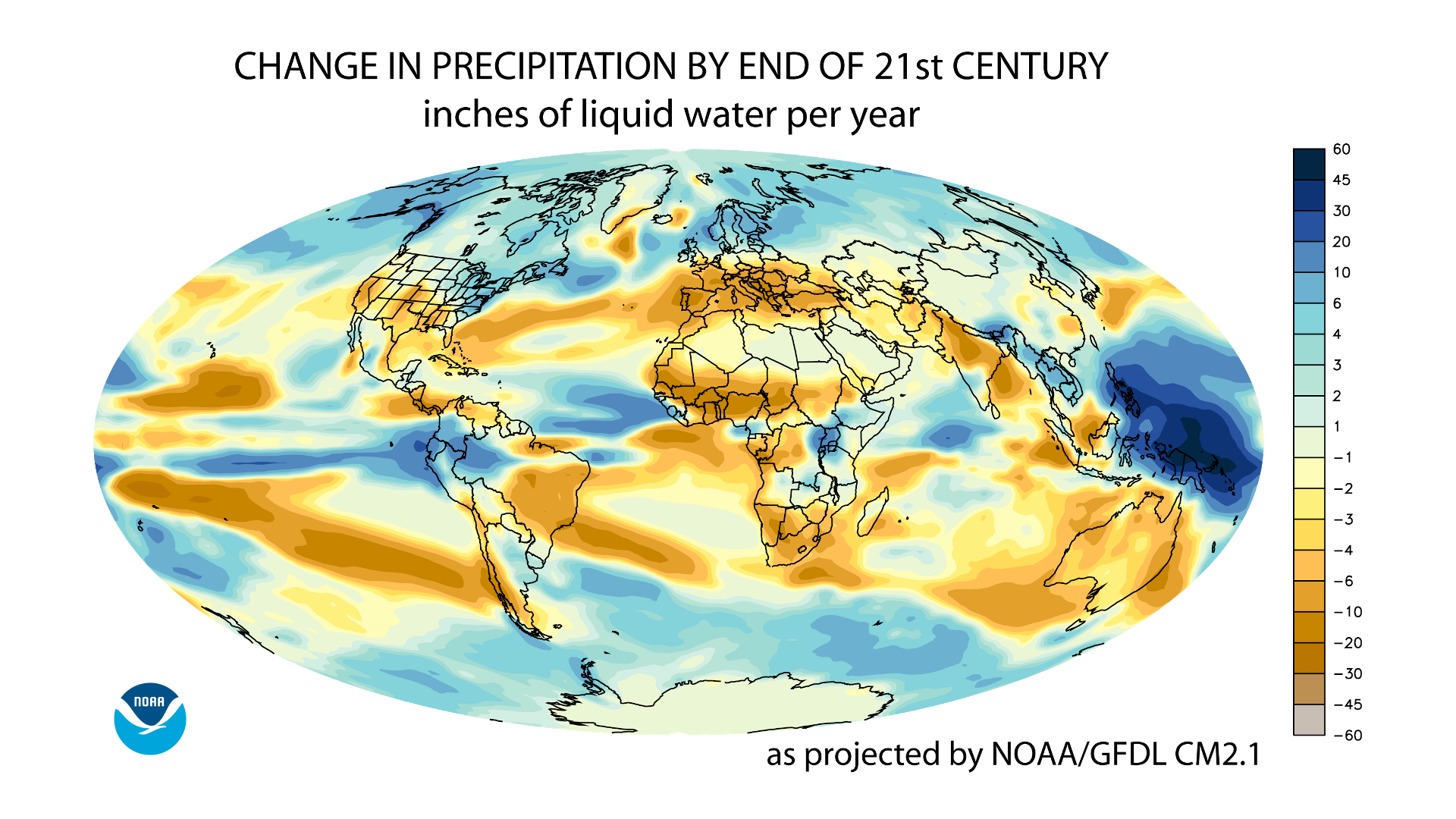
So what do the computer models predict? First, everywhere is going to get warmer, with the greatest change in the eastern Amazon region. Cool nights in the future will be warmer than current cold nights. The southeast and northwest will see increases in rainfall. The eastern Amazon, eastern and northeastern areas of Brazil will see decreases in precipitation, it seems mostly in the dry season.
Detailed Look at Future Climate
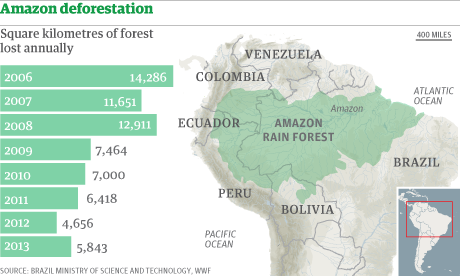
Increase in high temperatures in Central America, tropical and subtropical regions of the continent. Water supply shortages will increase because of less rainfall and more evaporation and transpiration as a result of higher temps. Chopping down the forests to make more room for agriculture and cattle ranching intensifies the effects of climate change. Though the rate of deforestation has slowed as seen in the image below, the ecological effects exacerbate climate change such as loss of biodiversity and increase of species extinction.
The continent has large groups of impoverished populations who are more vulnerable to climate change. Natural resources used for daily living become more scarce, and thus risks of malnutrition, lack of sanitation, and disease become more prevalent. It's somewhat uncertain as to how the continent's food supply will be effected. In some regions, decrease in precipitation will surely present new challenges, but projections for the Southeast show increases in rainfall, and thus potentials for greater productivity.
Most Interesting Threat
Climate change in South America is having measurable impacts on human health. There are new diseases popping up in non-endemic areas, places the disease never existed. What has changed you ask, why yes air temperature. Mosquitos like it hot. Malaria has been documented to have reached high in the Bolivian Andeas, where normally it's too cold for those midgies to survive. They bring with them Malaria and Dengue fever. But new habitats for mosquitos aren't the only issues. There are many other diseases such as the Schistosomiasis, Hantaviruse, Chagas disease, cutaneous leishmaniasis, river blindness, and cholera will each expand it's geographical domain. I chose this topic because I don't think about non-endemic viruses stretching their "wings" and flying to other places. But that's exactly what is happening.
Sixteen studies met the inclusion criteria and most studies showed that the transmission of dengue is highly sensitive to climatic conditions, especially temperature, rainfall and relative humidity. Studies on the potential impacts of climate change on dengue indicate increased climatic suitability for transmission and an expansion of the geographic regions at risk during this century. Source: http://www.biomedcentral.com/1471-2334/14/167
My perception of climate change has been sea level rise, loss of habitat, changes in temperature, precipitation. More drought less rain. I never considered the public health aspect and how these challenges can have an even greater impact on populations where public health issues are presently major concerns without the added burden climate change brings.


No comments:
Post a Comment